Meridians are channels of energy running throughout our bodies, and each meridian is related to a particular body 'organ' from which it takes its name. There are twelve major meridians and number of minor meridians related to each organ, and you will have seen diagrams or posters depicting the course of the various meridians over the surface of the human body. Although the majority of the meridians are related to physical organs that we in the West would recognise, not all of them are, and they do not necessarily work on the same physical basis.
For example, there are two 'organs' that are unknown to Western physiology: the Pericardium (or Heart Protector) and the Triple Burner, Sanjiao, or Triple Heater. The Pericardium protects the heart from emotional upsets and 'knocks', and protects us from external 'attacks' such as infections. The Triple Heater harmonises the organs and ensures the safe passage of energy and fluids through our bodies; malfunctioning is seen as causing Chi or body fluids to become blocked in our systems.
The word 'organ' does not have the same meaning in Chinese medicine as we would understand in the West when we think of the liver or the heart, for example. Each organ also has a much wider range of associations, characteristics, functions and influence than the physical organs we perceive in the West, and we are going to look at this in more detail later on. Each 'organ' functions on all levels of our body-mind-spirit, part of an overall dynamic energy process.
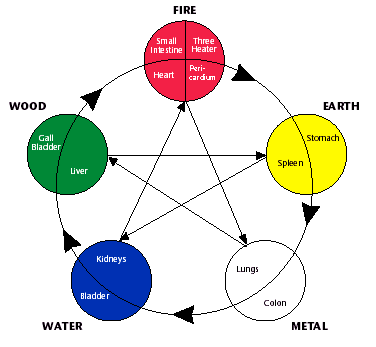
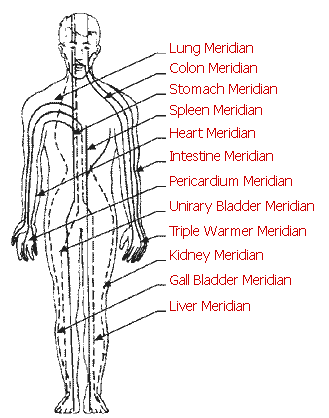 On this posting the meridians and particularly the 'organs' are important because each organ is allocated to a particular element, so if we want to work on Wood then we can focus energy on the 'organs' of Wood: Liver and Gall Bladder, and their associated meridians. We will we be focusing energy on these organs and we will be sending the organ's characteristic energy through it, intensifying the beneficial effect by making the 'organ' and its meridian resonate at its characteristic frequency. When we work on the Liver and the Gall Bladder we will be sending Wood energy through those organs, to produce balance in Wood on a deep level. We will produce balance in all the various ramifications and associations of Wood: anger, planning, decision-making, the tendons, the eyes, tears, and so on (see later discussions of the associations of each element). Usually two organs represent each element, one Yin organ and one Yang organ, one solid organ and one hollow organ.
The Yin organs are the solid organs: Liver, Heart, Heart Protector, Spleen/Pancreas, Lung and Kidney. These organs are considered to be deeper in the body and are concerned with the manufacture, storage and regulation of the fundamental substances. They each have an emotion associated with them. The Yang organs are hollow: Gall Bladder, Small Intestine, Triple Heater, Stomach, Large Intestine and Bladder. These organs are considered to be closer to the surface of the body, and have the functions of receiving, separating, distributing and excreting body substances.
Interestingly, in the same way that one element supports another in a continuous cycle, in TCM one organ/meridian can be seen as supporting the next. So the Heart supports and nourishes the Spleen, and this in turn nourishes the Lungs. The Lungs support the Kidneys, and these nourish the Liver. The Liver supports the Heart and so on. There are two other meridians outside the element classification, and they run down the front and back of the body in the midline. These meridians will be familiar to those carrying out the microcosmic orbit meditation: The Conception and Governing Vessels.
Five Elements Correspondences
In this section I want to touch on some of the important correspondences of the elements, for example the emotions, the 'organs', meridians and the various body parts connected with each element. The usefulness of this is that if you know that Metal is reflected in the emotion of grief, represents the lungs and the large intestine, and also the skin, then you can understand that:
• Constipation may be connected with suppressed grief.
• Helping someone to release suppressed grief can lead to skin condition improving,
as happened a while ago with someone I was working on.
The Emotions of the Elements
In Traditional Chinese medicine there are a number of internal causes of disharmony that are termed the 'seven emotions'. They are Anger, Joy, Sadness, Grief, Pensiveness, Fear and Fright. Sadness and Grief, and Fear and Fright, may be taken together, giving five basic causes of disharmony, one for each element.

In traditional Chinese medicine the emphasis is on balance, so none of the seven emotions are considered to be 'good' or 'bad' in themselves. What is important is how they balance. Negative connotations are not placed on anger, or any of the other emotions of the elements, though Western society tends to frown on the expression of anger and so this emotion tends to become suppressed, with knock-on effects in other areas (see later). All the emotions have their place in a healthy individual and they should be felt and expressed. Most people experience a wide range of emotions that vary in intensity; some are appropriate and adaptive, others are less so. Too much Joy is as out of balance as too much Grief, but the disharmony will express itself in a different way.
In this section I touch on the emotional associations of each element, and then we will move on to look at more basic characteristics of each element, particularly their associated 'organs', and the ramifications of these on various levels.
Wood: Anger
The emotion of Wood is anger and aggression, together with the associated feelings of irritability, hatred, fury and rage, resentment and frustration. Anger and aggression are a sign of an obstacle in our path, preventing us from growing, and we become frustrated if we cannot find the space for expression. Anger and aggression are seen as positive emotions that allow us to overcome impediments to our growth, but irritability, hatred, rage and fury are seen as signs of a Wood imbalance, and are not healthy emotions.
Rage, for example, can be seen as anger that has lost its purpose and gone out of control. We speak of 'blind rage'. A person might be continually angry with themselves or on edge with others, irritable and always wanting to pick a fight with someone. They might feel 'stuck', paralysed because they are unable to escape their fury. Annoyance and irritability can also be seen as energies that have yet to be focused.
If a person keeps their rage inside, it can seethe under a cold and polite surface; underneath there may be a feeling of great frustration or inner conflict, and if the rage ever broke free there might be dangerous consequences. Such suppressed aggression also goes hand in hand with suppressed and inhibited sexuality, so healthy sexual behaviour is seen as related to healthy aggressive behaviour.
Emotional imbalances in Wood can be expressed in different ways. For example, chronic irritability and unreasonable temper tantrums can be indicative of an excess of chi in the Gall Bladder. This can cause headaches in the crown and at the temples, and if this state of rage continues not to be expressed or cleared out then high blood pressure or Gallstones might result.
A person may exhibit suppressed rage: sarcasm, cynicism, bitterness and a general inability to become angry. This can be associated with apathy, sluggishness, resignation and depression, which in themselves are what we might see in a person who has given up making plans and manifesting goals (some of the other characteristics of the Liver and the Gall Bladder - see later). Such an outlook may have arisen because a person has been confronted continually with obstacles to their self-realisation. Continued failure can lead people to give up, perhaps leading to alcoholism or drug addiction, which are in themselves injurious to the Liver.
The last two paragraphs represent an excess of Yang energy in Wood, and a deficiency of Yang energy in Wood respectively. A lack of Yang energy might be caused by too much Yin energy in the Liver (the Yin organ) or a lack of Yang energy in the Gall Bladder (the Yang organ). This is where it all gets rather complicated, and for the purposes of this course, fortunately, we do not need to go deeper into the Yin and Yang characteristics of the elements, the organs and their emotions!
If over the years a person cannot express and clear their hatred and rage, and turn these emotions into a positive striving towards goals, then the aggression can turn itself against the person's own body, leading to gout, arthritis, rheumatism, and other autoimmune or auto-aggressive disorders. Interestingly, these diseases are more often found in women, and in patriarchal cultures women have less opportunity than men do to express themselves, especially when it comes to carrying through with an idea or venting their anger.
The healthy situation is where anger and aggression can be expressed and then will turn naturally into joy and love, the emotions associated with Fire, the element which follows Wood in the endless cycle of the elements.
Fire: Joy
In Chinese medicine the concept of Joy refers more to a state of agitation or overexcitement rather than our more passive notion of deep contentment, and Joy is related to the Heart. An imbalance in Fire will show itself as a lack of joy, or joy in excess, and both are harmful. If someone has an insatiable desire for permanent joy, and this is pursued relentlessly through work or play, then this can put too much stress on Fire and lead to, for example, palpitations and high blood pressure. Fire also governs the blood vessels. Excessive striving for joy is not healthy, and the stress involved may include a great deal of sexual frustration. An imbalance in fire almost always revolves around a relationship in the person's life, according to one author.
Since the elements are connected, and Wood supports Fire, a lack of chi in Wood - leading to suppression of anger - can also lead to a suppression in joy, so a person who is unable to properly express anger may be unable to fully experience joy.
Earth: Sympathy
Earth expresses itself through compassion, recognition, sympathy and a feeling of love and unity with one's environment, through a basic feeling that one is welcome and at home where one is at that moment. There is a self-assurance that does not need to be proven, an inner security and calmness.
So people with a deficiency in Earth feel insecure, sometimes begging for attention and affection. Beneath this behaviour lies the belief that warmth and affection could be taken away or denied. Childhood experiences can lead to this belief becoming established in a person. In fact, the search for missing security is the driving force and main occupation of people with a 'weak' Earth. They look for this security in eating or smoking, they might be overly affectionate - grasping for love - and constantly looking for the security of motherly love in their relationships. They can hide their fear of abandonment behind a romantic ideal of love and partnership.
The basic emotion of Earth is sympathy or compassion, so an imbalance in Earth can show itself in a person who lacks compassion, or who does not seem to enter into relationships with others. The affairs of others do not seem to touch them very much, and a critical stance towards others can go hand in hand with this, with harsh judgements and low tolerance masking an underlying insecurity. Voicing criticisms helps to build up the person's sense of superiority.
An imbalance could show itself as self-pity and constant whining about one's own problems, in martyrdom. An example that I read was that of a woman who sacrifices herself for her husband and children, not treating herself to anything; she can moan and point to her destiny as the reason for this. Maybe the person would seek sympathy continually, obsessively, and perhaps even make up symptoms to attract more compassion towards them. By contrast, they might be unable to receive sympathy themselves. Whether someone asks for sympathy all the time, or cannot receive it, they are 'stuck' and aren't able to move easily in and out of the emotion. In a balanced person, the emotions can flow freely. So a person with a healthy Earth has an 'inner abundance' from which to give and care for others, rather like the fullness and abundance that nature displays in late summer.
When this element is deficient, this 'sweetness' can turn into a constant overflow of 'sticky' emotional outbursts, or over-exaggerated generosity which serves to make others dependent; think of a mother who prevents her children from becoming adults by limiting their responsibilities and not allowing them to make decisions. Perhaps the person would be far too sympathetic, to the point of being obsequious.
Metal: Grief
If we follow the analogy of the seasons, and remember Metal's association with autumn, then we can imagine the state of mind in simple agricultural communities: wondering how they are going to last the winter as the cold dark days approach. There would be worries about the future, and Metal imbalance can display itself in just such a worry, but in an exaggerated form, with perhaps a pessimistic attitude, a hopelessness. By contrast, a healthy Metal would display trust in life, optimism and a positive view of the future.
The feeling autumn is sadness, a sadness that fills us when we have to leave something that has be come precious and dear to us. This feeling is exaggerated in people who are unable to let go of something that they can never get back. Thus the emotion of Metal is grief. An imbalance in Metal will show itself as being unable to grieve, suppressing grief, or in feeling a sense of loss continually, perhaps a sadness about things that have not yet happened, when we realise that we have not taken advantage of our opportunities.
Grief is a natural and a healthy process, of course, but a person who is overwhelmed by sorrow is likely to be displaying a Metal imbalance. Someone who is going through grief may experience breathing difficulties or bowel problems for a while, and sometimes these problems may persist; we will see later that the Lungs and the Large Intestine are the 'organs' of Metal.
Our Lungs hold the emotion of Grief, and they are directly involved in the expression of this emotion: a normal and healthy expression of grief and sadness is sobbing that originates in the depths of our lungs, deep breaths and the expulsion of air with the sob. Sadness that remains and becomes chronic can create a disharmony in the Lungs, weakening Lung chi, and this will interfere with the Lungs' many functions and energetic processes.
Water: Fear
The emotion of Water is fear, which is a healthy and natural response to dangerous situations, a normal and adaptive human emotion. We fear something concrete, recognise the danger in time, and we take action to get away from something that is threatening to us. Fear ensures our survival. But anxiety and terror are more intense because they are emotional states where the threat can't be assessed properly, and in fact the threat may be imaginary. Anxiety exists when a threat can't be judged correctly, or may no longer exist. We develop anxiety when we isolate ourselves and we aren't in harmony with things and people around us any more. Being able to 'resonate' with our environment is a characteristic of Water: to be soft, to surrender oneself and to not offer any resistance.
So a serious imbalance in Water can show itself as panic attacks, paranoia, a persecution complex, fear of the dark, a variety of phobias or even a general amorphous feeling of dread or foreboding, a pervading sense of anxiety about life. We may become rigid, immovable and paralysed by fear. Fear involves holding on to an anxiety rather than letting it go and, rather like a river that has been dammed; one can feel overwhelmed, inundated, sinking into despair. Only when the anxiety has been released can we move forward.
If you would Like to learn A Brief History of Ayurveda please read on
Rob LightbearerFor example, there are two 'organs' that are unknown to Western physiology: the Pericardium (or Heart Protector) and the Triple Burner, Sanjiao, or Triple Heater. The Pericardium protects the heart from emotional upsets and 'knocks', and protects us from external 'attacks' such as infections. The Triple Heater harmonises the organs and ensures the safe passage of energy and fluids through our bodies; malfunctioning is seen as causing Chi or body fluids to become blocked in our systems.
The word 'organ' does not have the same meaning in Chinese medicine as we would understand in the West when we think of the liver or the heart, for example. Each organ also has a much wider range of associations, characteristics, functions and influence than the physical organs we perceive in the West, and we are going to look at this in more detail later on. Each 'organ' functions on all levels of our body-mind-spirit, part of an overall dynamic energy process.
The Yin organs are the solid organs: Liver, Heart, Heart Protector, Spleen/Pancreas, Lung and Kidney. These organs are considered to be deeper in the body and are concerned with the manufacture, storage and regulation of the fundamental substances. They each have an emotion associated with them. The Yang organs are hollow: Gall Bladder, Small Intestine, Triple Heater, Stomach, Large Intestine and Bladder. These organs are considered to be closer to the surface of the body, and have the functions of receiving, separating, distributing and excreting body substances.
Interestingly, in the same way that one element supports another in a continuous cycle, in TCM one organ/meridian can be seen as supporting the next. So the Heart supports and nourishes the Spleen, and this in turn nourishes the Lungs. The Lungs support the Kidneys, and these nourish the Liver. The Liver supports the Heart and so on. There are two other meridians outside the element classification, and they run down the front and back of the body in the midline. These meridians will be familiar to those carrying out the microcosmic orbit meditation: The Conception and Governing Vessels.
Five Elements Correspondences
In this section I want to touch on some of the important correspondences of the elements, for example the emotions, the 'organs', meridians and the various body parts connected with each element. The usefulness of this is that if you know that Metal is reflected in the emotion of grief, represents the lungs and the large intestine, and also the skin, then you can understand that:
• Constipation may be connected with suppressed grief.
• Helping someone to release suppressed grief can lead to skin condition improving,
as happened a while ago with someone I was working on.
The Emotions of the Elements
In Traditional Chinese medicine there are a number of internal causes of disharmony that are termed the 'seven emotions'. They are Anger, Joy, Sadness, Grief, Pensiveness, Fear and Fright. Sadness and Grief, and Fear and Fright, may be taken together, giving five basic causes of disharmony, one for each element.
In traditional Chinese medicine the emphasis is on balance, so none of the seven emotions are considered to be 'good' or 'bad' in themselves. What is important is how they balance. Negative connotations are not placed on anger, or any of the other emotions of the elements, though Western society tends to frown on the expression of anger and so this emotion tends to become suppressed, with knock-on effects in other areas (see later). All the emotions have their place in a healthy individual and they should be felt and expressed. Most people experience a wide range of emotions that vary in intensity; some are appropriate and adaptive, others are less so. Too much Joy is as out of balance as too much Grief, but the disharmony will express itself in a different way.
In this section I touch on the emotional associations of each element, and then we will move on to look at more basic characteristics of each element, particularly their associated 'organs', and the ramifications of these on various levels.
Wood: Anger
The emotion of Wood is anger and aggression, together with the associated feelings of irritability, hatred, fury and rage, resentment and frustration. Anger and aggression are a sign of an obstacle in our path, preventing us from growing, and we become frustrated if we cannot find the space for expression. Anger and aggression are seen as positive emotions that allow us to overcome impediments to our growth, but irritability, hatred, rage and fury are seen as signs of a Wood imbalance, and are not healthy emotions.
Rage, for example, can be seen as anger that has lost its purpose and gone out of control. We speak of 'blind rage'. A person might be continually angry with themselves or on edge with others, irritable and always wanting to pick a fight with someone. They might feel 'stuck', paralysed because they are unable to escape their fury. Annoyance and irritability can also be seen as energies that have yet to be focused.
If a person keeps their rage inside, it can seethe under a cold and polite surface; underneath there may be a feeling of great frustration or inner conflict, and if the rage ever broke free there might be dangerous consequences. Such suppressed aggression also goes hand in hand with suppressed and inhibited sexuality, so healthy sexual behaviour is seen as related to healthy aggressive behaviour.
Emotional imbalances in Wood can be expressed in different ways. For example, chronic irritability and unreasonable temper tantrums can be indicative of an excess of chi in the Gall Bladder. This can cause headaches in the crown and at the temples, and if this state of rage continues not to be expressed or cleared out then high blood pressure or Gallstones might result.
A person may exhibit suppressed rage: sarcasm, cynicism, bitterness and a general inability to become angry. This can be associated with apathy, sluggishness, resignation and depression, which in themselves are what we might see in a person who has given up making plans and manifesting goals (some of the other characteristics of the Liver and the Gall Bladder - see later). Such an outlook may have arisen because a person has been confronted continually with obstacles to their self-realisation. Continued failure can lead people to give up, perhaps leading to alcoholism or drug addiction, which are in themselves injurious to the Liver.
The last two paragraphs represent an excess of Yang energy in Wood, and a deficiency of Yang energy in Wood respectively. A lack of Yang energy might be caused by too much Yin energy in the Liver (the Yin organ) or a lack of Yang energy in the Gall Bladder (the Yang organ). This is where it all gets rather complicated, and for the purposes of this course, fortunately, we do not need to go deeper into the Yin and Yang characteristics of the elements, the organs and their emotions!
If over the years a person cannot express and clear their hatred and rage, and turn these emotions into a positive striving towards goals, then the aggression can turn itself against the person's own body, leading to gout, arthritis, rheumatism, and other autoimmune or auto-aggressive disorders. Interestingly, these diseases are more often found in women, and in patriarchal cultures women have less opportunity than men do to express themselves, especially when it comes to carrying through with an idea or venting their anger.
The healthy situation is where anger and aggression can be expressed and then will turn naturally into joy and love, the emotions associated with Fire, the element which follows Wood in the endless cycle of the elements.
Fire: Joy
In Chinese medicine the concept of Joy refers more to a state of agitation or overexcitement rather than our more passive notion of deep contentment, and Joy is related to the Heart. An imbalance in Fire will show itself as a lack of joy, or joy in excess, and both are harmful. If someone has an insatiable desire for permanent joy, and this is pursued relentlessly through work or play, then this can put too much stress on Fire and lead to, for example, palpitations and high blood pressure. Fire also governs the blood vessels. Excessive striving for joy is not healthy, and the stress involved may include a great deal of sexual frustration. An imbalance in fire almost always revolves around a relationship in the person's life, according to one author.
Since the elements are connected, and Wood supports Fire, a lack of chi in Wood - leading to suppression of anger - can also lead to a suppression in joy, so a person who is unable to properly express anger may be unable to fully experience joy.
Earth: Sympathy
Earth expresses itself through compassion, recognition, sympathy and a feeling of love and unity with one's environment, through a basic feeling that one is welcome and at home where one is at that moment. There is a self-assurance that does not need to be proven, an inner security and calmness.
So people with a deficiency in Earth feel insecure, sometimes begging for attention and affection. Beneath this behaviour lies the belief that warmth and affection could be taken away or denied. Childhood experiences can lead to this belief becoming established in a person. In fact, the search for missing security is the driving force and main occupation of people with a 'weak' Earth. They look for this security in eating or smoking, they might be overly affectionate - grasping for love - and constantly looking for the security of motherly love in their relationships. They can hide their fear of abandonment behind a romantic ideal of love and partnership.
The basic emotion of Earth is sympathy or compassion, so an imbalance in Earth can show itself in a person who lacks compassion, or who does not seem to enter into relationships with others. The affairs of others do not seem to touch them very much, and a critical stance towards others can go hand in hand with this, with harsh judgements and low tolerance masking an underlying insecurity. Voicing criticisms helps to build up the person's sense of superiority.
An imbalance could show itself as self-pity and constant whining about one's own problems, in martyrdom. An example that I read was that of a woman who sacrifices herself for her husband and children, not treating herself to anything; she can moan and point to her destiny as the reason for this. Maybe the person would seek sympathy continually, obsessively, and perhaps even make up symptoms to attract more compassion towards them. By contrast, they might be unable to receive sympathy themselves. Whether someone asks for sympathy all the time, or cannot receive it, they are 'stuck' and aren't able to move easily in and out of the emotion. In a balanced person, the emotions can flow freely. So a person with a healthy Earth has an 'inner abundance' from which to give and care for others, rather like the fullness and abundance that nature displays in late summer.
When this element is deficient, this 'sweetness' can turn into a constant overflow of 'sticky' emotional outbursts, or over-exaggerated generosity which serves to make others dependent; think of a mother who prevents her children from becoming adults by limiting their responsibilities and not allowing them to make decisions. Perhaps the person would be far too sympathetic, to the point of being obsequious.
Metal: Grief
If we follow the analogy of the seasons, and remember Metal's association with autumn, then we can imagine the state of mind in simple agricultural communities: wondering how they are going to last the winter as the cold dark days approach. There would be worries about the future, and Metal imbalance can display itself in just such a worry, but in an exaggerated form, with perhaps a pessimistic attitude, a hopelessness. By contrast, a healthy Metal would display trust in life, optimism and a positive view of the future.
The feeling autumn is sadness, a sadness that fills us when we have to leave something that has be come precious and dear to us. This feeling is exaggerated in people who are unable to let go of something that they can never get back. Thus the emotion of Metal is grief. An imbalance in Metal will show itself as being unable to grieve, suppressing grief, or in feeling a sense of loss continually, perhaps a sadness about things that have not yet happened, when we realise that we have not taken advantage of our opportunities.
Grief is a natural and a healthy process, of course, but a person who is overwhelmed by sorrow is likely to be displaying a Metal imbalance. Someone who is going through grief may experience breathing difficulties or bowel problems for a while, and sometimes these problems may persist; we will see later that the Lungs and the Large Intestine are the 'organs' of Metal.
Our Lungs hold the emotion of Grief, and they are directly involved in the expression of this emotion: a normal and healthy expression of grief and sadness is sobbing that originates in the depths of our lungs, deep breaths and the expulsion of air with the sob. Sadness that remains and becomes chronic can create a disharmony in the Lungs, weakening Lung chi, and this will interfere with the Lungs' many functions and energetic processes.
Water: Fear
The emotion of Water is fear, which is a healthy and natural response to dangerous situations, a normal and adaptive human emotion. We fear something concrete, recognise the danger in time, and we take action to get away from something that is threatening to us. Fear ensures our survival. But anxiety and terror are more intense because they are emotional states where the threat can't be assessed properly, and in fact the threat may be imaginary. Anxiety exists when a threat can't be judged correctly, or may no longer exist. We develop anxiety when we isolate ourselves and we aren't in harmony with things and people around us any more. Being able to 'resonate' with our environment is a characteristic of Water: to be soft, to surrender oneself and to not offer any resistance.
So a serious imbalance in Water can show itself as panic attacks, paranoia, a persecution complex, fear of the dark, a variety of phobias or even a general amorphous feeling of dread or foreboding, a pervading sense of anxiety about life. We may become rigid, immovable and paralysed by fear. Fear involves holding on to an anxiety rather than letting it go and, rather like a river that has been dammed; one can feel overwhelmed, inundated, sinking into despair. Only when the anxiety has been released can we move forward.
If you would Like to learn A Brief History of Ayurveda please read on


 Posts
Posts


